

Sustainable Development Goals (498)
The Sustainable Development Goals are a universal call to action to end poverty, protect the planet and improve the lives and prospects of everyone, everywhere. The seventeen Sustaiable Development Goals (SDG) were adopted by all UN Member States in 2015, as part of the 2030 Agenda for Sustainable Development which set out a 15-year plan to achieve the Goals.
Children categories


2 Zero Hunger (13)
End hunger, achieve food security and improved nutrition and promote sustainable agriculture

3 Good Health and Well-Being (65)
Ensure healthy lives and promote well-being for all at all ages

4 Quality Education (45)
Ensure inclusive and equitable quality education and promote lifelong learning opportunities for all


6 Clean Water and Sanitation (34)
Ensure availability and sustainable management of water and sanitation for all

7 Affordable and Clean Energy (35)
Ensure access to affordable, reliable, sustainable and modern energy for all

8 Decent Work and Economic Growth (10)
Promote sustained, inclusive and sustainable economic growth, full and productive employment and decent work for all

9 Industry, Innovation and Infrastructure (30)
Build resilient infrastructure, promote inclusive and sustainable industrialization and foster innovation


11 Sustainable Cities and Communities (162)
Make cities and human settlements inclusive, safe, resilient and sustainable

12 Responsible Consumption and Production (59)
Ensure sustainable consumption and production patterns

14 Life Below Water (83)
Conserve and sustainably use the oceans, seas and marine resources for sustainable development

15 Life on Land (152)
Protect, restore and promote sustainable use of terrestrial ecosystems, sustainably manage forests, combat desertification, and halt and reverse land degradation and halt biodiversity loss

16 Peace, Justice and Strong Institutions (31)
Promote peaceful and inclusive societies for sustainable development, provide access to justice for all and build effective, accountable and inclusive institutions at all levels

17 Partnerships for the Goals (20)
Strengthen the means of implementation and revitalize the global partnership for sustainable development
(News alert: Katy did it!) Seventeen-year cicadas were just an opening act. Now the woods are rolling with the rhythm of our annual insects.
Written by Stephen Lyn Bales A true katydid is shown here. It’s one of the main insects that provides a permanent soundtrack to your summer life in the Knoxville area. Stephen Lyn Bales/Hellbender Press
What’s that buzz? We thought Brood X was over.
In case you haven’t noticed: It’s hot!
The “dog days of summer,” are so called because the season coincides with the period of time when the brightest star Sirius, aka the Dog Star, rises and sets with the Sun: early July through August into September.
The ancients believed that when Sirius and the Sun were in the sky together, the days were hotter. I think they got it right.
August has never been that thrilling to me, more of a month to endure. The birds have finished raising their families and are going through their late-season molt. Some of the migratory birds have already started to move south. But that doesn’t mean that our backyards are totally silent because late summer is cacophonous with insects.
During the day, the trees are filled with large, green cicadas that generally spend three years underground in their larval stage, but they are not all in sync like Brood X was, so each summer we have plenty that mature to collect en masse in our neighborhoods.
To attract females, the male cicadas do the chainsaw buzzing, but the songs are not made with vocal chords but rather special organs on the sides of their abdomens called “tymbals.” In effect, their sides vibrate loudly.
Locally in the Knoxville region we have five species of these annual cicadas. Early in the morning and into the afternoon, swamp cicadas (Neotibicen tibicen) are calling. They are also known as morning cicadas because they usually crank up by 10 a.m. with a long uninterrupted rattle that builds in intensity.
Clean-energy advocates take demands to base of TVA towers and power
Written by Thomas Fraser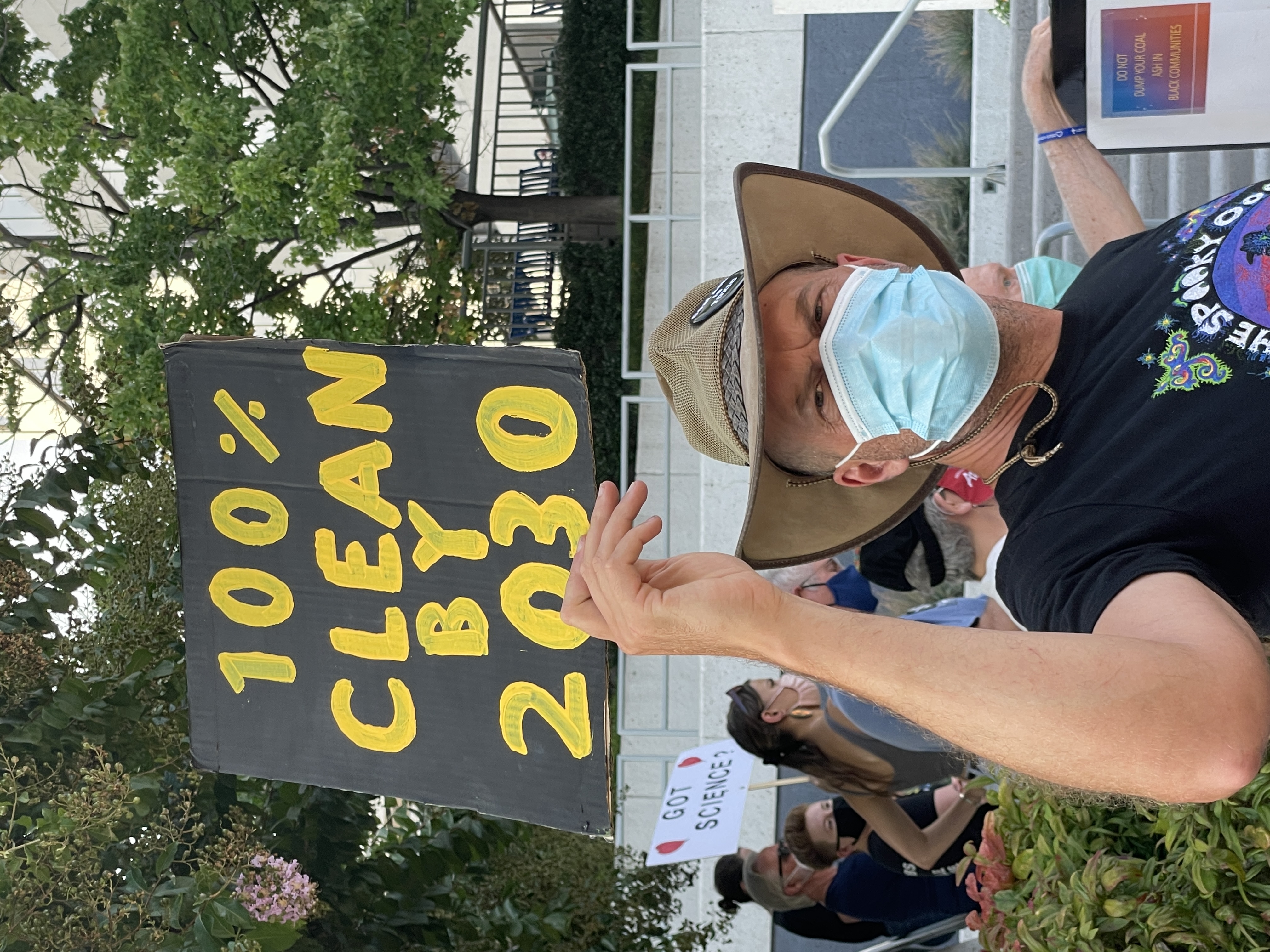 Alex Pulsipher holds a sign demanding that TVA transition to 100 percent renewable energy at a rally Wednesday in Market Square in Knoxville. Courtesy Amy Rawe/Southern Alliance for Clean Energy
Varied environmental groups offer unified plea for clean energy, coal ash management and accountability from TVA
It was people power generating energy at Market Square in downtown Knoxville on Wednesday.
A coalition of civic and environmental groups and their representatives met at the bottom of the two Tennessee Valley Authority towers urging the public utility to reopen meetings to public comment; swear off all fossil fuels by 2030; and carefully tend to the needs of those affected by coal ash and devise a plan to contain it for the safety of current and future generations.
- tva clean energy
- coal ash
- kingston coal ash spill
- southern alliance for clean energy
- kingston coal ash worker
- tva coal ash
- sunrise movement
- appalachian voices
- sierra club
- tennessee valley authority
- accountability
- public comment
- tva board meeting
- carbon reduction
- climate action
- carbon free by 2030
- renewable energy
Lead is flying as bald eagles face ambush on road to full recovery
Written by Stephen Lyn Bales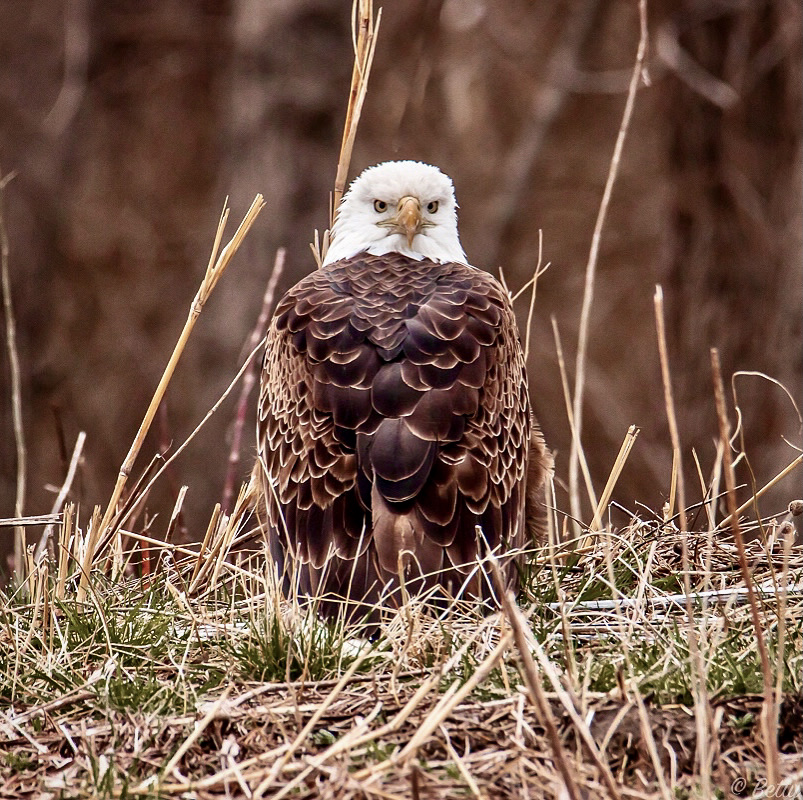 This grounded bald eagle at a wildlife refuge in Missouri eventually succumbed to lead poisoning. Lead from bullets and shot are the latest threat to bald eagles, the recovery of which is an American conservation success story. Betty Thompson
Once again bald eagles are in trouble: This time the threats are a deadly recipe of lead and neurotoxins.
The recovery of America’s bald eagles is one of the greatest environmental success stories of the past 50 years. From an estimated overall population of about 800 at the depth of their decline, they have rebounded to about 100,000 today living near water in Alaska, Canada and all of the lower 48 states.
Hellbender Press has covered the success story that brought our national symbol, the bald eagle, back from the brink of extinction.
The cause of that long-ago calamity was ferreted out with the help of an early citizen-scientist, a retired Canadian banker living in Florida named Charles Broley, who became interested in eagles and obtained a permit to band eaglets. Between 1939 and 1946 he banded a total of 814 of them in the nest before they fledged.
As the years passed Broley observed a population decline and initially thought habitat loss was to blame. But in an Audubon article he penned in 1958, Broley concluded, “I am firmly convinced that about 80 percent of the Florida bald eagles are sterile.”
But why? Broley was the first to speculate that the use of organochlorine pesticides, most notably dichlorodiphenyltrichloroethane, or DDT for short, was somehow the cause; but he had no proof and didn’t know how the chemical compound actually affected adult eagles.
Broley’s suspicions and others were brought to national attention by Rachel Carson in her landmark 1962 book, “Silent Spring.” DDT was outlawed in 1972 and the eagle population slowly began to recover.
And today? Bald eagles still face problems — both old and new.
The old one is lead poisoning.
News Sentinel: Anderson County ball fields built atop TVA coal ash
Written by Thomas FraserNews Sentinel: Toxic ash fill at Claxton ball field uncapped and unsealed
Tennessee Valley Authority used a mix of coal ash and dirt for fill during construction of a playing field that was later leased to Anderson County and the local Optimist Club for public use, reported Jamie Satterfield of the Knoxville News Sentinel.
She had earlier reported an adjacent playground was contaminated by coal ash byproducts, including heavy metals and multiple other toxins. The contaminants likely originated from coal-ash piles at the nearby Bull Run Fossil Plant.
Anderson County and the Claxton Optimist Club operate the playground and sports fields, which are still owned by TVA.
The playground was built about 20 years ago, during which time coal ash disposal was lightly regulated. The disposal of coal ash from facilities such as Bull Run coal plant, which will be closed by 2023, has proven a major environmental problem and challenge for utilities across the country.
Limbless bears break hearts but donuts may be worse than leg traps
Written by Ben Pounds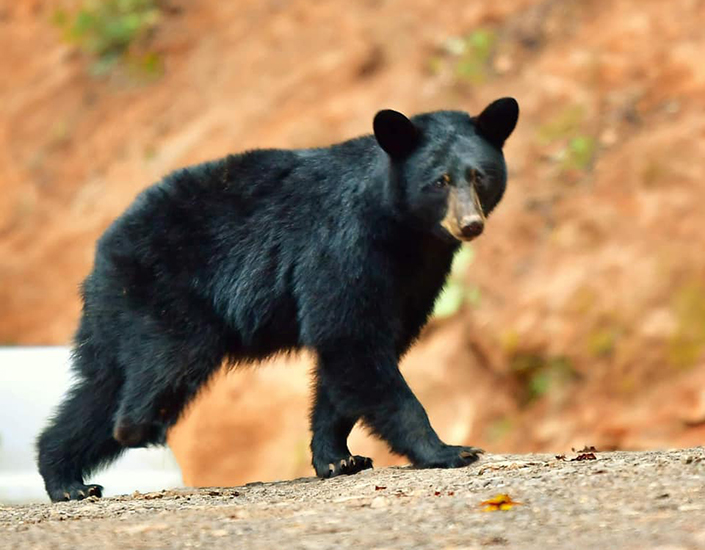 Courtesy of Help Asheville Bears
By any other name: From poaching to cars and traps, black bears face diverse human threats in Southern Appalachians
Activists and state agencies agree bear poaching is an age-old problem in the mountains of Tennessee and North Carolina, but they diverge when it comes to some key aspects of the crime and its prevention.
The non-profit Help Asheville Bears is raising awareness of threats to bears on both sides of the state lines and getting coverage on local media outlets like this piece on Knoxville-based WBIR. Its message has also appeared on a billboard in Sevierville. The Arden, N.C.-based group offers a tip line, rewards and also supports what could be described as a self-styled anti-poaching militia.
“Bear poaching is a big deal. It happens anywhere where there are bears,” said Jody Williams, the founder of Help Asheville Bears, which is responding to what its members see as an increasing threat to the very symbol of wild Southern Appalachia. HAB is especially concerned about trapping that Williams said has left limbless bears limping throughout the mountains.
- bear poaching
- smoky mountains bear poaching
- limbless bear
- legless bear
- save asheville bears
- twra bear
- bear trap
- trap sold on amazon
- poacher strike force
- help asheville bear
- leg trap
- leg trap amazon petition
- danger to bear
- don't feed bear
- bearwise
- tennesse wildlife resources agency
- north carolina wildlife resources commission
- black bear
Report: Children exposed to coal-ash pollutants in Knoxville-area playground
Written by Thomas FraserNews Sentinel: Playground near TVA’s Bull Run Fossil Plant contaminated by coal ash
Testing by independent Duke University researchers indicates a playground in the Claxton community contains dangerous levels of coal-ash byproducts.
The playground is near the Tennessee Valley Authority’s Bull Run steam plant, which has historically used vast amounts of coal to produce electricity and stored the resultant coal ash in huge landfills near the facility on Melton Hill reservoir near Oak Ridge. The plant will be decommissioned within two years, but questions remain about how TVA will handle the tons of remnant coal ash produced over the lifetime of the plant.
Duke University researchers sampled soil from the site, and results showed high levels of heavy metals and other toxins typically present in coal ash.
TVA maintains its testing has not detected harmful levels of contaminants in the area, but the News Sentinel’s Jamie Satterfield, who was been relentless in her investigations of TVA coal-ash policies and the disastrous Kingston coal slurry spill of 2008, noted that “There are no human health guidelines, however, for substances like coal ash that combine many toxins or radioactive metals.”
The 17-year cicada brood left behind some calling cards in the trees
Written by Alexandra DeMarco Here is some evidence of tree browning and “flagging” caused by the recent appearance of Brood-10 cicadas earlier this summer. Courtesy Oak Ridge National Laboratory
Tree “flagging” is a lingering sign of the 17-year cicadas’ brief time on Earth
(Alexandra DeMarco is an intern in ORNL’s media relations group.)
On the road leading to the U.S. Department of Energy’s Oak Ridge National Laboratory, drivers may notice that many of the green trees lining the entrance to the lab are dappled with brown leaves. At first glance, the sight isn’t extraordinary, as deciduous tree leaves turn hues of oranges and browns before falling to the ground each autumn.
Yet, just weeks past the summer solstice, this phenomenon is out of place and is in fact evidence of another natural occurrence: cicada “flagging.”
This spring, Brood X cicadas emerged from the ground after 17 years and swarmed across the eastern United States, leaving a trail of exoskeletons and echoes of mating calls. Cicadas emerge in such large quantities to withstand predation and successfully maintain their populations, and trees actually play a key role in their life cycle.
A male cicada attracts a female through a mating call, the sound responsible for cicadas’ shrill hum. After the two mate, the female cicada uses a sharp tubular organ called an ovipositor to slit the bark and split the sapwood of young tree branches to deposit her eggs there. These incisions, however, damage a tree’s vascular system and can cause stalks beyond the incision to die and wither, leaving behind twigs with brown leaves that resemble flags dangling from the trees.
The eggs then grow into nymphs that make their way to below ground. An oft-repeated misconception is that they’ll stay dormant for 17 years. Actually, during that time, they go through 5 life stages while feeding on the xylem (tree sap) of roots. This may further weaken saplings that were heavily infested with cicadas.
Tell TVA: Don’t replace Kingston Coal with new fossil gas plants or pipelines!
 Remember TVA’s 2008 Kingston Fossil Plant coal fly ash slurry spill
The Tennessee Valley Authority plans to retire the Kingston plant and its four other remaining coal-fired power plants by 2035.
But it is seriously considering replacing them with large fossil gas power plants and new gas pipelines!
Natural gas is cleaner than coal, but is yet another fossil fuel source that releases carbon dioxide. Such a replacement would be contrary to the national and global consensus that we must reduce the use of fossil fuels quickly to constrain the runaway climate crisis as much as we can.
A plan based on emerging technologies for increased energy efficiency combined with distributed use of renewable energies and energy storage can increase community resilience; create more good, long-term jobs; diversify local business opportunities; and provide immediate public health benefits.
TVA accepts public comments electronically through the end of July 15, 2021.
Don’t miss the opportunity to tell TVA that customers don’t want to pay for a yesteryear “solution” that does not really address the clear and present dangers to humanity. The Southern Alliance for Clean Energy has made it easy for you:
Submit your comment to TVA by tapping or clicking this link NOW:
Tell TVA, No New Fossil Gas Plants + Pipelines
You can also email TVA directly attn: Chevales Williams, This email address is being protected from spambots. You need JavaScript enabled to view it.
Source: TVA — Kingston Fossil Plant Retirement
The sounds of silence: 17-year cicadas fade away as offspring prepare for 2038 performance
Written by Stephen Lyn Bales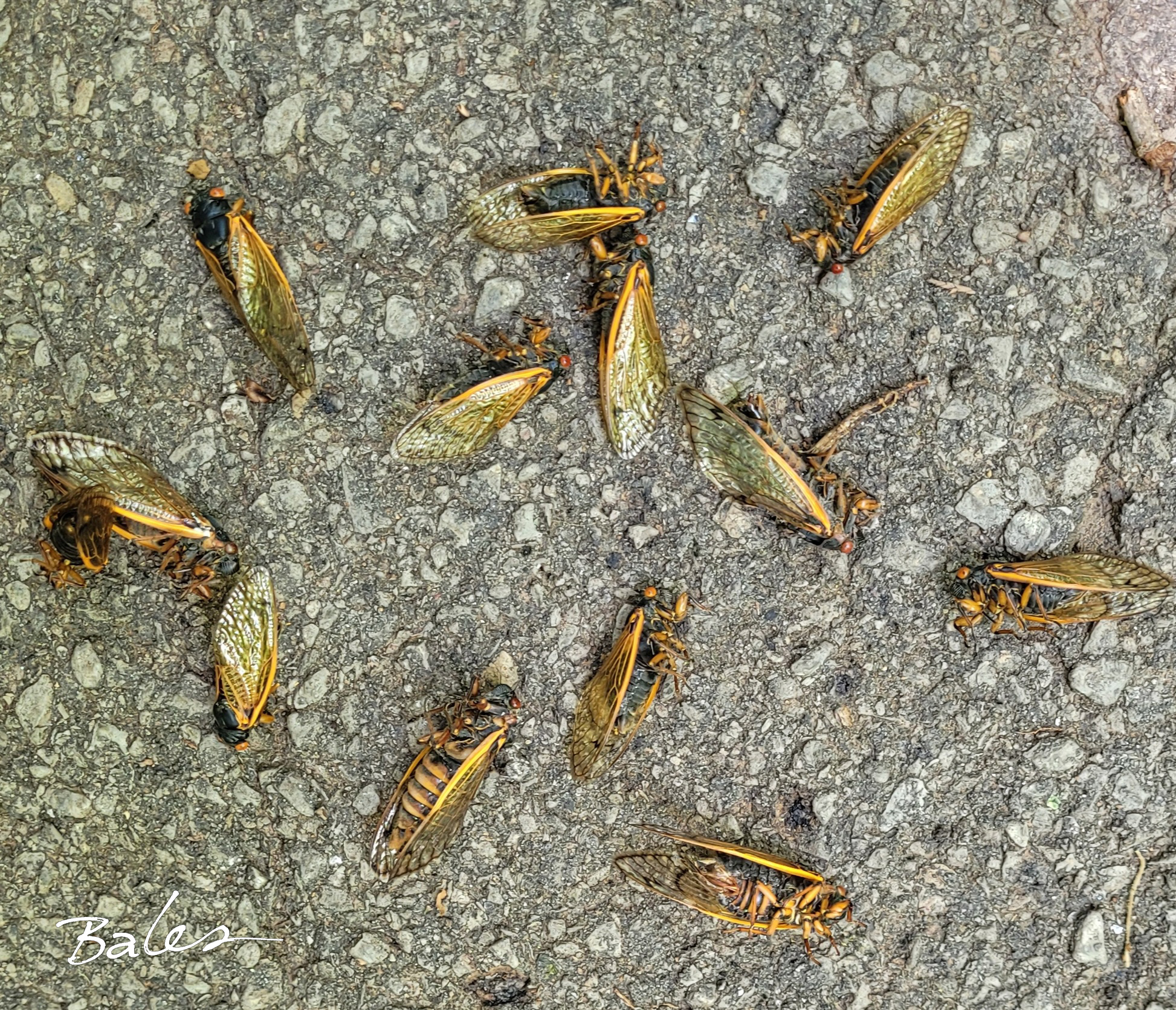 Dead cicadas are seen on concrete in Knoxville at Holston River Park. Their brief sonic reign has come to an end. Photo courtesy of Lyn Bales
The cicada soundtrack of spring and early summer has come to a quiet end
“Turn out the lights, the party’s over,” sings country music outlaw Willie Nelson. “They say that all good things must end.”
Yes. Essentially Cicadapalooza 2021 is over. There may be a few late emerging males hanging on like the last few guys in the bar at closing time with hope against hope that somehow they will get lucky and Miss Wonderful will walk through the door. In this case, a female 17-year cicada clicks and clicks to let the male know she is interested or desperate to complete her mission.
As a rule of thumb, the entire periodical cicada phenomenon lasts four to six weeks but it is extremely weather dependent. Insects are ectothermic and need warm to hot temperatures to be active.
I saw my first evidence the cicada emergence had begun at Ijams Nature Center, where I worked for 20 years as a naturalist. Executive director Amber Parker told me where to look for emergence holes: under the sugar maple at the back of the Universal Trail. That was on April 20. I found the small exit tunnels but no cicadas or exuviae. I knew skunks, foxes, crows, jays, owls, dogs, cats, and anything else that will eat a bug quickly consume the first ones above ground.
Despite Covid slowdowns and shutdowns, Smokies draws $1B in 2020 revenue to neighboring communities
Written by Thomas Fraser A Knoxville man tries his hand at fly fishing in Abrams Creek during a family camping trip on the southwestern side of Great Smoky Mountains National Park. Thomas Fraser/Hellbender Press
Green begets green in Smokies region; Big South Fork and Cumberland Gap also economic players
Recent federal analysis of spending by national park visitors is a testament to the economic benefits of environmental protection, scientific study and outdoor recreation.
The 12.1 million visitors to Great Smoky Mountains National Park in 2020 spent $1.024 billion in neighboring communities in both Tennessee and North Carolina, according to a study released this week by the National Park Service. Similar, localized releases were distributed into national park communities across the country.
Closer to home, that number represents the estimated visitor money spent in areas that include traditional “gateway” communities, such as Townsend and Gatlinburg, and Cherokee and Bryson City in North Carolina. Regionally, it’s at least a $5 million increase since 2012. Travel problems, housing and employee shortages, overdevelopment and environmental destruction are of course persistent in some of those areas.
- great smoky mountains economic impact
- great smoky mountains national park visitation
- conservation area economic impact
- big south fork
- big south fork national river and recreation area
- economic benefit of wild area
- obed
- cumberland gap
- federal park visitation and spending
- national park service units in tennessee
- economic impact of national parks in tennessee
The days the Earth stood still (Part 2): South Knoxville’s Ijams Nature Center weathered Covid with grit, gifts and gratitude. Naturally.
Written by Thomas Fraser Members of a Covid-era outdoor education class at Ijams Nature Center net insects. The South Knoxville nature center weathered the Covid-19 pandemic with donations, federal loan guarantees and common-sense maneuvering, like moving all educational programming outside. Photos courtesy Ijams Nature Center.
Ijams posted record visitation during pandemic even as resources were challenged
(This is the second in an occasional Hellbender Press series about the effects of the Covid-19 pandemic on the natural world. Here's the first installment about air quality improvements in the Smokies.)
Individuals and organizations can learn a lot from a pandemic.
You up your technology game. You innovate and run harder and get leaner. You realize the importance of face time (the real face time).
You learn the power of allies and those who really love you.
And in the case of Ijams Nature Center in South Knoxville, you learn just how much people need and value the natural world and the outdoors, especially in times of acute stress and uncertainty.
Ijams played host to a record number of visitors in 2020; there was no usual winter slowdown. Parking lots were full virtually every day during the height of the pandemic that claimed the lives of at least 600,000 people in the U.S. That visitation trend has continued at Ijams, with the coronavirus somewhat comfortably in the rear-view mirror.
An estimated 160,000 people visit the popular nature center annually, but there’s no exact count. Officials said the 2020 visitation substantially surpassed that number, and they plan a visitation study because a very “porous border” prevents an accurate count.
“The one great thing that has come out of Covid, is that people have recognized the importance of nature in their lives; they’ve recognized it as a place for solace, a place to get out and be safe and feel comfortable,” said Ijams Nature Center Executive Director Amber Parker.
“The sheer mass number of people coming were new to Ijams, or maybe come once or twice coming multiple times a week,” said Ijams Development Director Cindy Hassil.
“We were so excited to be this refuge for everyone,” Parker added.
The two women spoke on a sunny spring afternoon on the fetching expanse of stone terrace behind the visitors center in the shade of tulip poplars, red buds and dogwoods. Cardinals chirped and early 17-year cicadas throbbed behind a natural green curtain.
Bald eagles fly with the Tennessee angels who helped save them from extinction. We must keep them on the wing.
Written by Stephen Lyn Bales American Eagle Foundation founder Al Cecere releases a rehabilitated bald eagle at Ijams Nature Center on Aug. 12, 2016. The foundation named her Summit in honor of UT Lady Vols basketball coach Pat Summit. Photo by Chuck Cooper.
Is the bald eagle’s remarkable comeback fading down the stretch?
(Part one in a series)
It was a damp morning in early spring 2005 when Paul James and I met Linda Claussen at Seven Islands Wildlife Refuge along the French Broad River in east Knox County. Heavy rains had fallen through the night, but the clouds were beginning to break. As we walked down Kelly Lane toward the river the vocalized yearnings of thousands of chorus frogs could be heard singing from the soppy floodplain along the river. Spring was definitely here.
The refuge itself was the brainchild of Linda’s late husband, Pete. In the late 1990s, he formed the Seven Islands Foundation, a privately owned land conservancy, and began setting aside property to be protected and restored to a variety of natural habitats. Most of the acreage had recently been fescue pasture maintained for grazing livestock and hay production.
Western US in midst 20-year mega-drought
Read about it or listen to Randy Simon’s 2-minutedrought podcast on National Public Radio’s Earth Wise web page.
Loghaven in South Knoxville melds natural and human habitats to serve regional artists
Written by Tracy Haun Owens Sanders Pace Architecture blended the collection of the decades-old cabins at Loghaven in South Knoxville with the existing natural environment. Photos by Anna Lawrence/Hellbender Press
Loghaven: An award-winning natural and built environment in South Knoxville intends to get minds moving
Five years after he first saw the property that would become Loghaven Artist Residency, architect Brandon Pace was in one of the renovated cabins, listening to a performance by now-late composer Harold Budd, in town to perform at the 2019 Big Ears music festival.
The experience brought home the full potential of a truly special place.
“That was wonderful,” Pace said of that moment. “You could see it being a place for a composer. You saw this could be something. You could see how our city comes alive in events like this.”
This spring, Knoxville-based Sanders Pace Architecture was awarded a 2021 AIA Architecture Award for the design and architectural rehabilitation work at the 90-acre Loghaven property, which is owned and managed by the Aslan Foundation.
“The role they play in supporting good design in our community cannot be overstated,” Pace said of the Aslan Foundation.
Team member Michael Davis was awarded the 2021 AIA Young Architects Award.
On June 1, Loghaven Artist Residency opened up the application process for its second class of in-person residents, artists who work in visual, performing, literary, and interdisciplinary artistic fields.
“Save Loghaven”
Loghaven is a uniquely quirky part of Knoxville history. It began as a collection of log cabins in a heavily wooded area along Candora Road in South Knoxville.
The cabins were built as rental properties by single mom and entrepreneur Myssie Thompson in 1935, in the middle of the Great Depression. Her cabins, as well as one built by neighbor John Hightower, are the heart of the property.
Generations of UTK students and professors, young professionals, and others rented the alluring cabins. But by the late 1990s, the area was sinking into disrepair, with kudzu, privet, and other invasive plants growing up around the cabins and previously cleared areas.
Michaela Barnett wants to help break your consumer chains
Written by Thomas Fraser Michaela Barnett is the founder and owner of KnoxFill. She is seen here outside her South Knoxville home-based business in this submitted photo.
KnoxFill offers Knoxville home delivery and pickup of sustainably sourced personal-care products in refillable containers
Michaela Barnett has traveled the world, is an accomplished science writer and editor and is closing in on a doctorate from the University of Virginia.
Now she’s a business owner with a focus on sustainability and waste reduction and that has proven to be her true raison d’etre. She gets out of bed with joyous purpose and determination. And she sings to start her day.
“My husband says it’s like living with this annoying Disney character,” she said with a light laugh.
“I’ve got so much energy and joy and excitement,” said Barnett, who launched KnoxFill in March after eight months of research and preparation and works out of her home to fill multiple orders each day.
KnoxFill offers sustainably sourced personal-care items, detergents and other everyday household products in reusable glass containers for pickup or delivery. The product line includes shampoo, conditioner, body wash, lotions, laundry detergent, and dishwashing and castile soap. Barnett even offers safety razors, bamboo toothbrushes and refillable toothpaste “bites.”
- knoxfill
- reusable packaging
- sustainable product
- avoid packaging
- sustainable personal care item
- personal care delivery
- limit waste
- landfill
- incinerator
- fossil fuel
- refillable product
- personal care bottle refill
- environmental justice
- petrochemical product
- microplastic
- sustainable shopping
- consumerism
- consumer choice
- shopping
- green product
- conscientious shopper
More...

Dollywood joins Tennessee Aquarium effort to limit the introduction of cigarette butts to our shared waterways.
“As all humans need access to clean water, it’s an incredibly important treasure to protect.” — Dr. Anna George, Tennessee Aquarium vice president of conservation science and education.
Cigarette butts are everywhere, and are perhaps so familiar they go unnoticed by the millions of people who pass them on our streets and roads.
Not only are they unsightly, they contaminate our water resources — the puddles after a sudden rainstorm, the streams that flow through our landscapes, and the stormwater drains that ultimately lead to the Tennessee River. The butts quickly break down, polluting water with “tiny plastic fibers and a devil’s cocktail of chemical compounds,” according to the Tennessee Aquarium.
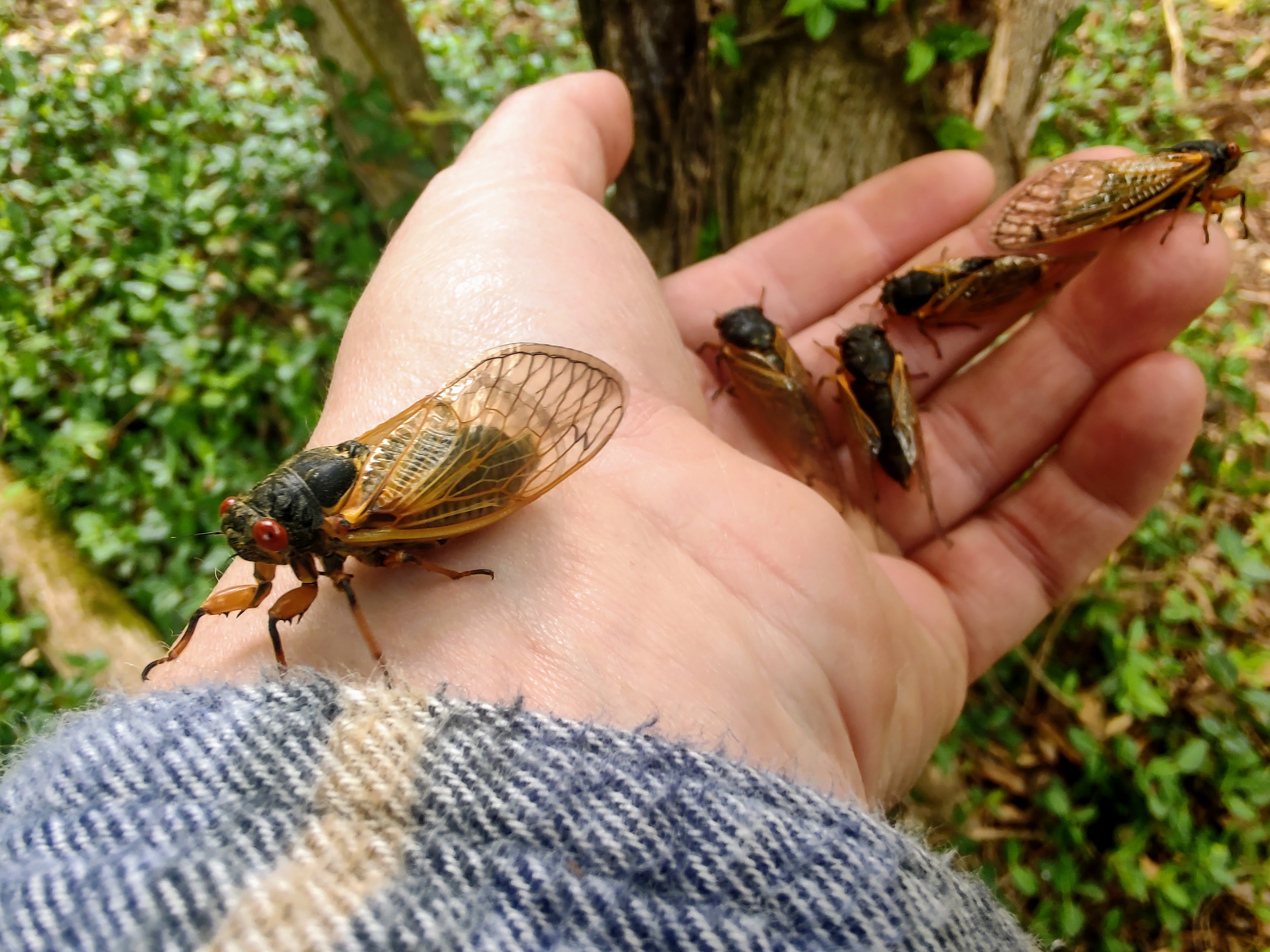 Eva Millwood holds Brood X cicadas on her property in South Knoxville in this submitted photo.
We will see a groundswell of East Tennessee 17-year cicadas as the heat comes on.
We have been hearing about it for weeks, online and on TV and in print. After 17 years underground, millions of cicadas are going to climb out of their burrows, shed their juvenile skins, unfurl their wings and fly up into the trees for one last grand jester of panache and reproduction and death. You even read about Brood X cicadas in Hellbender Press.
The Tennessee Wildlife Resources Agency posted a recent Instagram photo of a wild turkey jake with a crop stuffed full of cicadas, and there are reports of cicadas emerging en masse in parts of Tennessee. But your local searching self may ask: Where are they?
Insects are largely ectothermic. That means their body temperature comes from the surrounding air, water or ground temperature. The periodical cicadas need a ground temperature of roughly 68 degrees, eight inches deep to become very active. And we really have not had that for a sustained length of time.
Last week seemed to be destined to be the first big week of the emergence of Brood X. Monday started strong but the weather turned unusually cool for early May with daytime highs in the low 60s. Some of the cicadas started to ease out but it was primarily dozens, not hundreds or thousands, and certainly not 1.5 million per occupied acre. And remember, they are not everywhere.
Face your fears: It’s time to have a global conversation about spider conservation
Written by John R. Platt U.S. Fish and Wildlife Service biologist Susan Cameron searches moss mats for the spruce-fir moss spider in this USFWS photo.
European spidey senses should give us pause across the pond.
This story was originally published by The Revelator.
Despite their enormous ecological values, new research reveals we don’t understand how most arachnid species are faring right now — or do much to protect them.
Spiders need our help, and we may need to overcome our biases and fears to make that happen.
“The feeling that people have towards spiders is not unique,” says Marco Isaia, an arachnologist and associate professor at the University of Turin in Italy. “Nightmares, anxieties and fears are very frequent reactions in ‘normal’ people,” he concedes.
Clean air activists praise TVA’s coal decision; warn it’s not enough to meet climate goals
Written by Thomas Fraser
SACE: TVA must also wean itself off natural gas and nuclear reliance
As previously reported by Hellbender Press, Tennessee Valley Authority plans to shut down its five remaining coal plants by 2050 and pursue a carbon-neutral future.
TVA board members spoke favorably of the decision at its regular meeting on Thursday.
“TVA CEO Jeff Lyash shared a vision of how TVA will continue to support the Valley for years to come with a commitment to sustainability. The board also endorsed a strategic focus on decarbonization and a commitment to providing a reliable, low-cost energy supply as TVA moves into the future,” according to a statement released Thursday by TVA.
“TVA leadership issued a Strategic Intent and Guiding Principles document to provide direction for developing business strategies that provide reliable, resilient, low-cost and clean energy to the region. View the Executive Summary of the document.
“TVA’s new Carbon Report outlines TVA’s commitment and path to reduce carbon in the coming years without compromising the reliability and low rates the Valley has come to expect. The report outlines TVA’s leadership today in carbon reduction, our plan to achieve 70 percent reduction by 2030, our path to 80 percent reduction by 2035 and our aspiration to achieve net-zero carbon by 2050.”
Knoxville-based Southern Alliance for Clean Energy generally lauded TVA’s sustainability mission, but released the following detailed response Thursday afternoon:
“The agency’s intentions fall far short of the Biden Administration’s goal of decarbonizing the nation’s electric grid by 2035, a timeframe recommended by scientists to avoid the worst impacts of climate change.