

Sustainable Development Goals (498)
The Sustainable Development Goals are a universal call to action to end poverty, protect the planet and improve the lives and prospects of everyone, everywhere. The seventeen Sustaiable Development Goals (SDG) were adopted by all UN Member States in 2015, as part of the 2030 Agenda for Sustainable Development which set out a 15-year plan to achieve the Goals.
Children categories


2 Zero Hunger (13)
End hunger, achieve food security and improved nutrition and promote sustainable agriculture

3 Good Health and Well-Being (65)
Ensure healthy lives and promote well-being for all at all ages

4 Quality Education (45)
Ensure inclusive and equitable quality education and promote lifelong learning opportunities for all


6 Clean Water and Sanitation (34)
Ensure availability and sustainable management of water and sanitation for all

7 Affordable and Clean Energy (35)
Ensure access to affordable, reliable, sustainable and modern energy for all

8 Decent Work and Economic Growth (10)
Promote sustained, inclusive and sustainable economic growth, full and productive employment and decent work for all

9 Industry, Innovation and Infrastructure (30)
Build resilient infrastructure, promote inclusive and sustainable industrialization and foster innovation


11 Sustainable Cities and Communities (162)
Make cities and human settlements inclusive, safe, resilient and sustainable

12 Responsible Consumption and Production (59)
Ensure sustainable consumption and production patterns


14 Life Below Water (83)
Conserve and sustainably use the oceans, seas and marine resources for sustainable development

15 Life on Land (152)
Protect, restore and promote sustainable use of terrestrial ecosystems, sustainably manage forests, combat desertification, and halt and reverse land degradation and halt biodiversity loss

16 Peace, Justice and Strong Institutions (31)
Promote peaceful and inclusive societies for sustainable development, provide access to justice for all and build effective, accountable and inclusive institutions at all levels

17 Partnerships for the Goals (20)
Strengthen the means of implementation and revitalize the global partnership for sustainable development
Monday, 23 October 2023 09:26
Homeward bound: local students release hundreds of lake sturgeon into Tennessee River
Written by Casey Phillips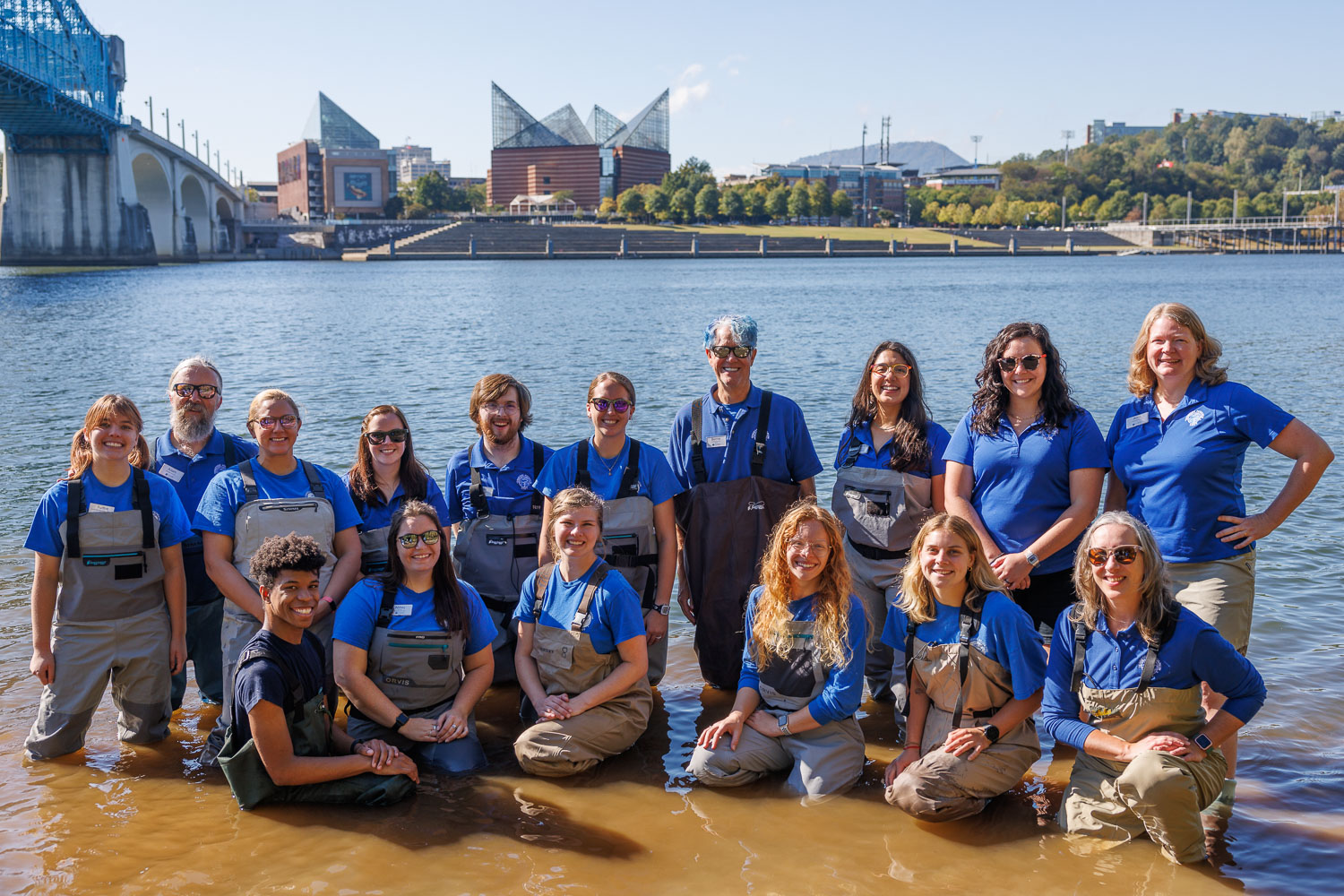 Conservation scientists with the Tennessee Aquarium Conservation Institute pose in the Tennessee River before releasing more than 600 juvenile lake sturgeon into the waterway. Tennessee Aquarium
CHATTANOOGA — After bulking up all summer on a steady diet of bloodworms and brine shrimp, hundreds of juvenile lake sturgeon finally were returned to their ancestral waters this morning.
Under a nearly cloudless autumn sky, biologists from the Tennessee Aquarium Conservation Institute and third through fifth grade students from Girls Inc. of Chattanooga’s Fall Break Camp gathered on the north bank of the Tennessee River in Coolidge Park.
One by one, they carefully made their way to the river’s edge holding clear, water-filled plastic buckets containing five-month-old lake sturgeon. Amidst excited squeals and nervous laughter, they squatted down, gently depositing each sleek, armor-skinned fish into the shallows.
This latest release “class” included 667 lake sturgeon. Comparatively tiny now, these miniature river giants have the potential to reach nine feet in length and could live for up to 150 years.
Reintroduction events like this are the capstone payoff to a summer spent tirelessly caring for and — most of all — feeding these sturgeon, says Reintroduction Biologist II Teresa Israel.
“It’s really special. It’s hard to see them go, but it’s a happy day since we’ve seen them get so big, so we know they’ll be successful out there,” she said. “It’s a great accomplishment that completes the circle for all our hard work.”
Lake Sturgeon are considered endangered in Tennessee. As recently as the 1970s, this species had disappeared from both waterways due to the impacts of damming, poor water quality and over-fishing. Today’s release is the latest in the now-23-year-old effort to bring Lake Sturgeon back to the Tennessee River and Cumberland River.
Published in
News

Despite strong US popular support for the UN, House Appropriations Bill wants to eliminate UN funding
NEW YORK — In a poll of nearly two thousand registered voters, 73% of respondents from across the political spectrum support America’s engagement with the United Nations.
Conducted by Morning Consult in August 2023, the survey finds that roughly two-thirds of Republicans and 86% of Democrats believe it’s important for the U.S. to “maintain an active role” in the UN.
UN favorability stood at 52%, with a plurality of Republicans saying they view the UN in a positive light.
More than half of all voters support paying full dues to the UN’s regular budget, and an even greater percentage (nearly 60%) are in favor of paying dues to the UN’s peacekeeping budget.
These numbers reflect similar nationwide data — including a 2023 survey by Pew Research — noting strong UN favorability among Americans.
What’s at stake?
The House budget proposal recommends eliminating funding for the UN regular budget — for the first time in history. That would cause the U.S. to lose its vote in the UN General Assembly!
Why that would be a grave and costly mistake is well explained by Jordie Hannum, Executive Director of the Better World Campaign.
This UN Day, make sure to tell your members of Congress that you support the UN’s mission.
Here are easy to follow help and sample scripts for your call and for leaving voice mail. Or, send them a customizable email message.
“As Congress considers making drastic cuts in U.S. contributions to the UN, this is a powerful reminder that Americans value the institution and want the U.S. to stay involved,” said Peter Yeo, President of the Better World Campaign. “The UN is a critical space for the U.S. to demonstrate our global leadership and support our allies. Americans clearly understand that it’s in our best interest to nurture this vital relationship.”
Published in
News
Saturday, 21 October 2023 17:09
Study expounds upon evolution of mosquitoes and their hosts
Written by Mick Kulikowski
This story was originally published on Phys.org and authored by Mick Kulikowski, Director of Strategic Communications and Media Relations at NC State University
Raleigh, NC — Researchers at North Carolina State University and global collaborators have mapped the mosquito’s tree of life, a major step toward understanding important traits, such as how the insects choose their hosts, feed on blood and spread disease. The findings will help researchers make better predictions to model disease transmission and understand what makes some mosquitoes better disease carriers than others.
The research suggests mosquito evolution over the past 200 million years mirrors the Earth’s history of shifting land masses and changing host organisms, said Dr. Brian Wiegmann, William Neal Reynolds Professor of Entomology at NC State and corresponding author of a paper describing the mosquito family tree.
The William Neal Reynolds Professorship is one of the highest distinctions available to NCSU faculty members.The Reynolds Professorships were established in 1950 by William Neal Reynolds, a long-time president and board chairman of the R.J. Reynolds Tobacco Company, to recognize and support outstanding faculty achievement in research, teaching and extension.
“This ongoing project builds a big-data resource that mines the academic literature with published observations of the sources of blood mosquitoes drink, from animals as diverse as fish to humans,” Wiegmann said. “It focuses explicitly on data collection to infer aspects of mosquito biology in a contextualized way. That means linking up the family, or phylogenetic, tree with the narrative of life on Earth: geologic history, climate history and organism history.”
Published in
Feedbag
 Editor’s note: The Environmental Management Waste Management Facility (EMWMF) was planned with sufficient capacity to properly accommodate all the problem waste to be generated by the cleanup of the Oak Ridge Reservation. However, to accelerate the cleanup and reduce the cost of preprocessing demolition waste, highly toxic waste was not systematically separated from less contaminated waste that would not have required disposal under Superfund criteria. Thus, EMWMF was approaching its capacity much sooner than projected. Hence, DOE began planning the Environmental Management Disposal Facility (EMDF) on land designated to remain uncontaminated during DOE’s Stakeholder Stewardship process of the late 1990s.
What did EPA Administrator Regan know when he overruled his experts?
WASHINGTON — A controversial decision by Biden’s Environmental Protection Agency may compromise the protectiveness of radiation cleanups across the country, yet the agency will not release the material explaining the basis for this decision, according to a federal lawsuit filed by Public Employees for Environmental Responsibility (PEER). The suit seeks to find out why EPA allowed a landfill at Oak Ridge, Tennessee, one of the nation’s largest nuclear waste sites, to pollute local waters over the objections of its top legal experts.
The Tennessee Department of Environmental Conservation (TDEC) had objected to plans by the U.S. Department of Energy (DOE) to build a landfill for radiological wastes and debris from demolished structures from the Y-12 National Security Complex and Oak Ridge National Laboratory. TDEC protested that wastewater from the landfill would contaminate Bear Creek, a tributary of the Clinch River. EPA’s acting Regional Administrator agreed with the state.
Published in
News
Tagged under
- public employees for environmental responsibility
- peer
- environmental protection agency
- us department of energy
- doe
- federal lawsuit
- tennessee department of environment and conservation
- tdec
- bear creek valley
- michael regan
- andrew wheeler
- clean water act
- oak ridge superfund site
- superfund program
- freedom of information act
- foia
- carlton waterhouse
- environmental management disposal facility
- emdf
- environmental management waste management facility
- emwmf
- regulatory capture
Thursday, 19 October 2023 08:02
Creation Care Alliance announces the 2024 Winter Symposium
Written by Thomas Fraser
ASHEVILLE — The theme of our 2024 Creation Care Alliance Symposium is “Sacred Symbiosis: Relationships for Eco-Justice.” Our presentations, workshops and conversations will explore the relationships needed to build and nurture justice for all creation–human and non-human. We’re excited to dive in and learn together!
Hosted at Montreat Conference Center in Black Mountain, the symposium will begin on Friday, February 2nd, with a full day of workshops and conversations and will run through Saturday, February 3rd.
Our keynote speaker, Mary Crow of Indigenous Environmental Network (IEN), will speak on the 3rd.
Unlike past years, Friday and Saturday’s programs are open to all and will not be limited to clergy. We hope you join us!
Discounts:
- Early-bird discount. Register before December 4th to receive $15 off both days of the conference. If you attend both days, that is $30 savings!
- Group discount. Groups of three or more people from the same congregation are eligible for the group discount of $10 off both days of the conference. If your group attends both days, that is a $20 discount per person. This offer is open until the close of registration on January 19th. The link for group discounts can be found on the symposium registration page (follow the below link).
- Student discount. If you are a current student, you can attend the symposium for a fraction of the cost ($20 on Friday and $30 on Saturday). We hope you will join us!
Published in
Voices
Wednesday, 18 October 2023 16:05
“It has been a fantastic career. It has been kind of like a fantastic dream for me. A fantastic wonder.”
Written by Rachel Kovac Bart Carter retired after a 30-year career at TWRA. He is credited with improving backpack electrofishing equipment commonly used by conservationists around the country. Tennessee Wildlife Resources Agency
Electrofishing innovator retires after 30 years of service with TWRA
MORRISTOWN — Bart Carter, Tennessee Wildlife Resource Agency Region 4 Fisheries Program Manager, has retired after three decades of service to the state’s wildlife resources.
During his 33-year career, his work included improving hatcheries, enhancing fish habitat, restoring streams to native fish fauna, helping discover new species, adding public access areas, and mentoring employees.
One of his most significant developments during his career was designing and building new backpack electrofishing equipment.
“Electrofishing can be an effective tool for fish community sampling, fish relocation, invasive species eradication, (and) sampling fish tissue contaminants,” said Mark O’Neal, director of ETS Electrofishing systems, LLC in Madison, Wisconsin.
“The tools they use just stun fish and doesn’t kill them. It stuns them out and then they can weigh them and put a tag on them, without having to using a pole with a hook or a net,” O’Neal said.
“It puts out a high DC voltage pulse. On a boat system you have to use a larger pulse. More DC power to drive a current in the water. When the fish experience a DC current they go to the anoid,” O’Neal said.
Published in
News
Tagged under
- bart carter
- tennessee wildlife resource agency
- ets electrofishing system
- mark o’neal
- john hammonds
- region 4 reservoirs fisheries biologist
- region 4 fisheries program manager
- twra region 4
- american fisheries society
- rainbow trout
- warmwater streams biologist
- national park service
- south holston
- watagua
- clinch
- powell
- nolichucky
- french broad
- east tennessee river
Tuesday, 17 October 2023 23:02
Dogwood Arts sets out to keep Knoxville blooming — one yard at a time
Written by Hellbender Press
Annual Bazillion Blooms campaign focused on planting a Dogwood in every yard across East Tennessee
It’s planting time in Tennessee! Dogwood Arts is on a mission to Keep Knoxville Blooming by selling dogwood trees through their annual Bazillion Blooms program. Bare-root trees (2-4ft tall) are on sale now for $25 each (or $20 each when five or more are purchased). The trees are disease-resistant, April-blooming, and available in either white or pink flowering varieties. Orders can be placed year-round, but trees are distributed in the fall to coincide with optimal planting time for successful growing.
Trees ordered through Nov 16 will be available for pick-up at the Dogwood Arts office (123 W Jackson Avenue) on Friday, Dec. 8 from 10AM-4PM and Saturday, Dec 9 from 9AM-12PM. Tree orders can be placed online at https://www.dogwoodarts.com/bazillionblooms or by calling Dogwood Arts at (865) 637-4561. Since 2009, over 14,500 dogwood trees have been added to East Tennessee’s landscape through the Bazillion Blooms program.
Published in
News
Wednesday, 11 October 2023 15:05
APIEL 2023, Oct. 21 — the 14th Appalachian Public Interest and Environmental Law Conference
 ELO is a student-run organization at the University of Tennessee College of Law. It is not directly affiliated with the University of Tennesse or any particular non-profit organization. It is dedicated to providing students and attorneys with learning opportunities and leadership experiences.
Networking environmental leaders across Appalachia and the State of Tennessee
Knoxville — APIEL is a relative newcomer to the small circle of inclusive U.S. public interest environmental law conferences. Because it is organized by law school student volunteers, APIEL is affordable to attend for citizens from all walks of life. Students are free!
APIEL is much loved and considered essential by regional nonprofit leaders and activists. It is also highly acclaimed by seasoned environmental lawyers. With just 13 conferences under its belt, APIEL has risen to rank among leading peer conferences with a much longer track record, such as the Public Interest Environmental Law Conference (PIELC) at the University of Oregon School of Law (41 events), the Red Clay Conference at the University of Georgia School of Law (35) and the Public Interest Environmental Conference (PIEC) at the University of Florida’s Levin College of Law (29).
 Oct. 24 - 31, everybody is encouraged to learn about bats and get involved in their conservation. National Park Service
An excellent time to celebrate bats
ASHEVILLE — Last year, the public was invited to “Bats N Brews” in honor of Bat Week at Sierra Nevada Brewing Company. This year we have not heard yet of any event to celebrate bat week in the southern Appalachians. Who will step up this year? Please let us know of any related activities. Or at least celebrate with family and friends. This article includes great recipes, too.
Bat Week is an international, annual celebration designed to raise awareness about the need for bat conservation. Bats are vital to the health of our natural world and economy. Although we may not always see them, bats are hard at work all around the world each night — eating tons of insects, pollinating flowers, and spreading seeds that grow new plants and trees.
Published in
News
Wednesday, 11 October 2023 10:38
Tennessee Project Milkweed orders top 300,000 and exhaust the free supply. TDOT says there’s more to come.
Written by Hellbender Press Monarch butterfly feeding off milkweed. TDOT launched a program to promote milkweed production, a common source of food for butterflies, birds and other insects.
Free milkweed seed will help citizens restore landscapes and preserve habitat; orders commence again in June for popular TDOT project
NASHVILLE — Amid unprecedented citizen demand, the Tennessee Department of Transportation (TDOT) halted online orders for free milkweed seed, offered as part of its Project Milkweed. Launched in June 2023, this mail-order resource was aimed at restoring landscapes and preserving habitats for monarch butterflies and other pollinator species. Since June, TDOT has taken nearly 131,000 individual orders from Tennesseans for milkweed seed. In total, 779,601 red and common milkweed seed packets were requested. The program will return in June 2024.
“TDOT is happy to offer such a popular program to the public, and to empower Tennesseans to do their part in saving pollinators as they are vital to life, growing food, and the economy of Tennessee,” said TDOT Commissioner Butch Eley in a release.
Orders exhausted a stock of 300,000 milkweed seed packets by Sept. 30. Additional seed material has been ordered and is expected to arrive in October. All remaining orders will be fulfilled then, according to TDOT.
Published in
News
Tuesday, 10 October 2023 12:09
Global temperatures are off the charts for a reason: 4 factors driving 2023’s extreme heat and climate disasters
Written by Michael Wysession
2023’s weather has been extreme in many ways. AP Photo/Michael Probst
This story was originally published by The Conversation. Michael Wysession is Professor of Earth, Environmental and Planetary Sciences, Arts & Sciences at Washington University in St. Louis.
Between the record-breaking global heat and extreme downpours, it’s hard to ignore that something unusual is going on with the weather in 2023.
People have been quick to blame climate change – and they’re right: human-caused global warming plays the biggest role. The weekslong heat wave that started in June 2023 in Texas, the U.S. Southwest and Mexico would have been virtually impossible without it, one study found.
However, the extremes this year are sharper than anthropogenic global warming alone would be expected to cause. September temperatures were far above any previous September, and around 3.1 degrees Fahrenheit (1.75 degrees Celsius) above the preindustrial average, according to the European Union’s earth observation program.
July was Earth’s hottest month on record, also by a large margin, with average global temperatures more than half a degree Fahrenheit (a third of a degree Celsius) above the previous record, set just a few years earlier in 2019.
Published in
News
Tagged under
- michael wysession
- climate change
- copernicus climate change service
- noaa space weather prediction center
- temperature variability
- underwater volcanic eruption
- solar fluctuation
- el nino
- weather extreme
- extreme heat
- la nina
- el nino southern oscillation
- enso
- pacific
- sea surface temperature
- global average temperature
- water vapor
- aerosol
- air pollution
- heat wave
- forest fire
- flash flood
- climate model
Friday, 06 October 2023 17:59
Woods and Wildlife Field Day scheduled for October 19

Educational event features opportunities to learn about forest management
OAK RIDGE — The 2023 Woods and Wildlife Field Day will include topics focusing on current research and forest stewardship practices that will help landowners with forest management goals. This field day presented by the University of Tennessee Institute of Agriculture is scheduled for October 19, 2023, at the UT Forest Resources AgResearch and Education Center and UT Arboretum in Oak Ridge.
“We are excited to share on a variety of topics related to natural resources research and management in Tennessee,” says Kevin Hoyt, director of the Forest Resources AgResearch and Education Center. “Not only is the information timely for forest management, but it’s also the perfect time of year to enjoy the fall colors at the center.”
Friday, 06 October 2023 13:56
Learn-to-Fish clinic and Music Jam at Oconaluftee visitor center
Written by Thomas Fraser
CHEROKEE — Great Smoky Mountains National Park will host a free youth fishing clinic and an Old Time Music Jam at the Oconaluftee Visitor Center on Saturday, October 21, 2023. Both events are free and open to the public.
In collaboration with the International Game Fish Association, the park will hold the fishing clinic from 10 a.m. to 3 p.m. Try your hand casting a line for local trout and earn your Junior Ranger Angler badge. Learn about fish conservation and ethical angling practices at fun, interactive stations. All fishing equipment will be provided. The first 25 families will receive a free fishing pole to keep! A valid Tennessee or North Carolina fishing license is required for participants 16 or older.
Published in Feedbag, Event Archive, Great Smoky Mountains National Park, Water, 4 Quality Education
Published in
Feedbag
Thursday, 05 October 2023 22:25
ORNL, TSU to partner on research education programs
Written by Thomas FraserThe Department of Energy’s Oak Ridge National Laboratory and Tennessee State University have signed a memorandum of understanding to strengthen research cooperation and provide diverse undergraduate students enriching educational research opportunities at the lab. This collaboration will further cement relationships between the lab and minority serving institutions, encouraging students from underrepresented backgrounds to achieve their professional goals.
ORNL is devoted to accelerating the pipeline of future workforce by offering educationally oriented, mission-aligned STEM student experiences with world-class researchers and staff.
“It is important to foster students’ natural curiosity in STEM education and research,” said Susan Hubbard, ORNL’s deputy for science and technology. “Through ORNL’s partnership with Tennessee State University, we will offer hands-on learning experiences, helping students to develop critical skills and a passion to impact their communities through research opportunities.
“The programs also provide an opportunity for diverse students to learn about how national laboratories work to address complex, pressing challenges. Helping to develop the STEM workforce of tomorrow’s problem-solvers is important to ORNL and the nation,” Hubbard said.
While adhering to Tennessee State University’s curricular requirements, students will gain access to educational programs at ORNL as interns during their undergraduate studies.
“This collaboration will strengthen and support our students’ overall preparation and contributions particularly as it relates to the mission of ORNL and the Department of Energy. Furthermore, this opportunity will broaden TSU’s research capacity and capabilities via access to state-of-the-art facilities and resources at ORNL,” said Quincy Quick, TSU’s associate vice president for Research and Sponsored Programs.
Students will engage in research activities through internship programs in DOE mission areas including renewable energy and materials, neutron scattering, fusion and fission energy technologies, national security research, manufacturing, environmental sciences and computer sciences.
Additionally, interns may have the opportunity to work with ORNL’s premier research facilities such as the Oak Ridge Leadership Computing Facility (home of the world’s fastest supercomputer Frontier), the High Flux Isotope Reactor, the Spallation Neutron Source and the Center for Nanophase Materials Sciences — all DOE Office of Science user facilities — plus the DOE Manufacturing Demonstration Facility at ORNL.
ORNL and TSU will commit to increasing the number of students in science, technology, engineering and mathematics, or STEM, fortifying the talent reservoir for workforce development and fostering collaborative mentoring opportunities for students.
For more information, please visit energy.gov/science. — Natori Mason
Published in
Feedbag
Join in a great event on Saturday, Oct. 7 for Sturgeonfest 2023 where you will have the opportunity to see the release of baby sturgeon into the French Broad River.
When: Saturday, Oct. 7, 2023 from 10 a.m. to 2 p.m.
The sturgeon release will begin at 11 a.m. and there are 1,000 baby sturgeon to release.
Due to habitat degradation, barriers to migration, overharvest and pollution, lake sturgeon have been almost extirpated from much of the Southeast US for more than 50 years.
In 2015, the N.C. Wildlife Resources Commission joined surrounding states in the Southeast Lake Sturgeon Working Group in an effort to restore lake sturgeon to the Tennessee and Cumberland river systems.
Brood stock comes from the Wolf River in Wisconsin, where the U.S. Fish and Wildlife Service works with Wisconsin Department of Natural Resources to collect eggs and milt for transportation and hatching at the Warm Springs National Fish Hatchery in Georgia.After hatching and growing, lake sturgeon are sent to the USFWS National Fish Hatchery at Edenton, N.C. and the Wildlife Commission’s Table Rock State Fish Hatchery for several months before release.
Approximately 2,000-9,000 juvenile lake sturgeon have been stocked annually in the French Broad River since 2015.
Dylan Owensby of the U.S. Fish and Wildlife Services says lake sturgeon are slow-growing, long-living fish. They might live up to 150 years and can grow more than 6 feet and up to 200 pounds. Females mature at 14 to 33 years of age and reproduce only once every four or more years. Males mature at 8 to 20 years of age. Sturgeon are bottom dwellers feeding on larval insects, crayfish and mollusks.
Learn more about lake sturgeon in the French Broad, watch Tennessee Wildlife Resource Agency’s sturgeon reintroduction video and read other Hellbender articles on sturgeon.
If you are an angler in Tennessee and lucky enough to catch a sturgeon, please let TWRA This email address is being protected from spambots. You need JavaScript enabled to view it. know (as explained in the video linked above) specially if it is a lunker.
Published in
Feedbag
Tagged under
- sturgeonfest
- seven island state bird park boat ramp
- french broad river
- dylan owensby
- southeast lake sturgeon working group
- warm springs national fish hatchery
- sturgeon reintroduction
- sturgeon recovery
- sturgeon release
- us fish and wildlife service
- lake strugeon release
- acipenser fulvescens
- tennesse wildlife resources agency
- twra
More...
Friday, 29 September 2023 11:53
Appalachian State Energy Center is crushing it with biochar
Written by Hei-Young Kim Community biochar production in Boone. Appalachian State Energy Center
Appalachian State University research helps farmers and crop yield
This article was provided by Appalachian State University. Hei-Young Kim is laboratory manager and research assistant with the Appalachian Energy Center.
BOONE — The Appalachian State Nexus Project experiments continue to advance agricultural innovations with biochar to help local farmers. Biochar is a charcoal-like material produced from plant material such as grass, agricultural and forest residues that produce carbon-rich material used for agriculture and horticulture purposes.
Adding biochar to soil increases surface area, pH, plant nutrient availability, and enhances water-holding capacity, according to Appalachian State researchers. It also can sequester carbon in the ground for extended periods of time, which may otherwise find its way into the atmosphere as CO2 or methane.
The qualities of biochar vary depending upon the material it comes from — timber slash, corn stalks or manure.
Published in News, ES! Initiatives, Earth, 12 Responsible Consumption and Production, 13 Climate Action
Published in
News
Tagged under
Monday, 25 September 2023 21:00
Traditional downtowns are dead or dying in many US cities
Written by John Rennie Short
Lunch atop a skyscraper, first published in the New York Herald-Tribune, Oct. 2 1932.  Charles Clyde Ebbets
View the story behind this famous photograph of the structure which was known initially as the RCA building, then GE building, now 30 Rockefeller Plaza. It also is a story about the national solidarity felt during the Great Depression — emblematic for EarthSolidarity!™ needed now to deal with our present global emergencies.
‘All that is solid melts into air’
John Rennie Short is professor emeritus of public policy at the University of Maryland. This article was originally published in The Conversation.
The hollowing out of U.S. cities’ office and commercial cores is a national trend with consequences for millions of Americans. As more people have stayed home following the COVID-19 pandemic, foot traffic has fallen and major retail chains are closing stores, and prestigious properties are having a hard time retaining tenants.
(Some Southeastern cities, like Knoxville, Asheville and Greenville have seen the opposite occur).
In May 2023 the shuttering of a Whole Foods market in downtown San Francisco received widespread coverage. Even more telling was the high-end department store Nordstrom’s decision to close its flagship store there in August after a 35-year run.
In New York City, office vacancy rates have risen by over 70% since 2019. By spring of 2023 Chicago’s Magnificent Mile, a stretch of high-end shops and restaurants, had a 26% vacancy rate.
A recent study from the University of Toronto found across North America, downtowns are recovering from the pandemic more slowly than other urban areas and “older, denser downtowns reliant on professional or tech workers and located within large metros” are struggling the hardest.
Like many U.S. cities, Portland, Oregon, is losing downtown businesses. This cuts into urban revenues and creates a perception of decline.
Over more than 50 years of researching urban policy, U.S. cities have weathered through many booms and busts. Now there is a more fundamental shift taking place. Traditional downtowns are dying or on life support across the U.S. and elsewhere. Local governments and urban residents urgently need to consider what the post-pandemic city will look like.
Published in
News
Tagged under
- whole foods
- john rennie short
- chicago’s magnificent mile
- university of toronto
- university of maryland
- nordstrom
- portland, oregon
- repurposing office space
- biotech labs
- the conversation
- hollowing out of city
- retail chain
- postpandemic retail
- store closing
- downtown retail
- urban policy
- excess commercial space
- vacant office space
- tax revenue
- zoom town
- ridership decline
- public transportation
- abandoned mall
- zoning law
- urban property market
- telecommute
- virtual meeting
Tuesday, 19 September 2023 16:47
Oak Ridge research suggests rough weather ahead
Written by Oak Ridge National LaboratoryOAK RIDGE — Researchers from Oak Ridge National Laboratory and Northeastern University modeled how extreme conditions in a changing climate affect the land’s ability to absorb atmospheric carbon — a key process for mitigating human-caused emissions. They found that 88 percent of Earth’s regions could become carbon emitters by the end of the 21st century.
Climate extremes lasting months or years could reduce plant productivity, which governs Earth’s capacity to produce food, fiber and fuel. Events such as wildfires could generate bursts of emissions from carbon stored in forests.
The team used the open-source Community Earth System Model to simulate multiple variables, which enabled a holistic understanding of how climatic conditions interact.
“Our results suggest that meteorological extremes will become more frequent, intense and widespread due to the compound effect of high temperature, drought and fire,” said ORNL’s Bharat Sharma. “Tropical regions may face these to the most extreme degree.”
Published in
Feedbag
Tagged under
Monday, 11 September 2023 12:47
Public can learn more about distilled Knox Urban Forest Master Plan Sept. 13
Written by Thomas Fraser
KNOXVILLE — Trees Knoxville and the city will update citizens on progress on the Urban Forest Master Plan. Trees Knoxville, an organization dedicated to preserve and increase the urban tree canopy on private and public lands in Knoxville and Knox County, will host an open house from 5:30-7 p.m. Sept. 13, at the Public Works Service Center (3131 Morris Ave.) to discuss the latest Urban Forest Master Plan.
Trees Knoxville and city urban forester Kasey Krouse will share recommendations from Urban Canopy Works LLC based on public input.
“We have taken everything we’ve learned over the last year and developed draft goals, as well as strategies and action steps to meet those goals,” Trees Knoxville Steering Committee said in a release. “While the plan is not yet fully developed, we would like to update the community on the direction the plan is headed, providing an opportunity to give feedback before the final draft is produced.”
This forum will update the planning process Trees Knoxville and city staff have been working on with a consultant from Urban Canopy to learn about the public thoughts, opinions and goals for the city’s urban canopy — tree cover in public places and on private property.
The hope is a successful forest plan will help the city preserve, grow and care for trees, which play a significant role in public and environmental health.
Published in
Feedbag