
Silver-Line later obtained the permit, part of an expansion of its outdoor storage, without those stipulations in 2024, about a year after Burton retired.
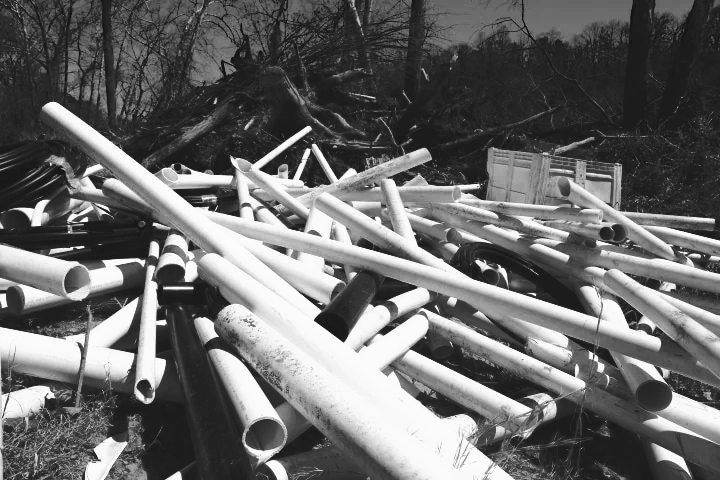
Crews working for the environmental nonprofit MountainTrue and funded by a state contract have removed more than 376,000 pounds of pipe from an area that stretches between the Silver-Line facility and Tennessee’s Douglas Lake, said Jon Stamper, the nonprofit’s river cleanup operations director. Taxpayers have spent more than $1 million on the effort. And it’s nowhere near done.
IPEX largely receded from public view in the storm’s aftermath. Earlier this year, a public pressure campaign led by MountainTrue called on the multinational corporation to take action to prevent pollution in future floods. Since then, in meetings with Woodfin officials and MountainTrue staff and in a statement shared with the Watchdog, it has committed to shoring up its storage practices.
But the window of opportunity to regulate that standard through local government enforcement has likely shut, at least for now. The lone path forward may be betting that IPEX will protect its own commercial interests in a way that prevents a repeat of the pollution Helene caused.
“I am enthusiastic that IPEX wants to make these changes, that they heard our concerns from the community and they are willing to put their own money to make the enhancements that better serve them and better serve the river,” Anna Alsobrook, the French Broad Riverkeeper, said this week, after a meeting between IPEX brass and MountainTrue staff. “I don’t want their pipes in the river, and they probably don’t want to lose millions of dollars of pipe.”
‘A bit of a revelation’
Silver-Line, Woodfin’s largest employer, was founded in 1962, and it has been storing its products a stone’s throw from the French Broad for decades — since well before IPEX bought it in 2019, and long enough to become an unquestioned feature of the area’s industrial landscape. In 2022, when an inquiry about permitting for a project to expand Silver-Line’s outdoor storage area made its way to Burton, he nearly gave it a green light without much thought.
But when he looked at satellite images of the parcel in question, he had “a bit of a revelation,” he said in an email to Nick Bowman, an engineer at Davis CivilSolutions, who was working on the storage-expansion project for IPEX. Most of Silver-Line’s outdoor storage at the time was concentrated on the southernmost of the two parcels that make up its campus. But the property that Burton was looking at, on the complex’s north end, also included storage, particularly a gravel lot on the north end that was full of open-topped containers.
Burton could imagine those containers floating off in a big flood; less than a year earlier, floodwaters from Tropical Storm Fred had swept away materials from an outdoor storage facility on Smokey Park Highway. He was inclined to hold off on issuing a permit until Silver-Line presented a removal plan or a tie-down system. The town’s floodplain development ordinances didn’t directly address outdoor storage, he acknowledged, but he was liberally interpreting a section about “temporary non-residential structures.”
Bowman pushed back, noting that Silver-Line leased the gravel lot to a different company and that the containers weren’t structures. (The lot has since been used to store PVC pipe; Bowman did not respond to requests for comment.) Burton held his ground. Bowman never responded.
Burton retired in April 2023. According to public records, Silver-Line restarted the permitting process a few months later, and one was issued the following spring. By then, the project was already underway, with the storage area it had once leased and a connecting driveway both freshly paved. It’s not clear whether Silver-Line got a permit for this work, or whether it needed to: Nathan Pennington, the county planning director, said it may have obtained one after the fact.
“A paving permit in the special flood hazard area in the 100-year [flood zone], it’s not a big deal,” he said. “It’s when you start getting into structures that it becomes a more intense review.”
After Helene, Burton grew frustrated with the situation at Silver-Line. He was especially appalled at IPEX’s silence during the long cleanup, he said. His intervention may not have prevented the disaster — Helene’s flooding was enormous, and the conditions he sought would have covered only a small part of the Silver-Line campus — but they may have set a precedent for the company’s practices moving forward.
“It just absolutely infuriated me,” he said, “because there were people that were advised that storage, at least in that area — and if you connect the dots why not everywhere else — was a bad idea.”
But other officials said Burton made his demands from shaky ground. The county managed Woodfin’s flood damage prevention ordinances from 2010 until last year, and Pennington said that, as he understood it, the county could enforce only its own standards, not higher standards held by Woodfin. (That’s not explicit in the interlocal agreement; Pennington said it was the advice of county attorneys.) Woodfin town manager Shannon Tuch agreed that the conditions would’ve been unenforceable, though not because of the agreement — she just didn’t think town ordinances supported them.
“It doesn’t mean that we love the practice of that kind of storage,” she said, “but from a regulatory standpoint, I don’t know that there was any mishandling.”
And the warnings did not go entirely unheeded: IPEX spokesperson Anastasia Georgakakos said this week that Burton’s recommendations were considered during a 2023 review of Silver-Line’s emergency response plan, which included a provision “for moving finished pipe away from the river during severe weather.”
Ahead of Helene, employees at the Silver-Line facility moved the pipe stored closest to the river to the opposite side of the property, close to Riverside Drive, Georgakakos said. But so swollen was the river that the plan was moot: The water, which Georgakakos said “reached approximately 300 feet farther into the property than any previous flood in the facility’s 64-year history,” took the pipe anyway.
“We were prepared for a 100-year flood,” she said. “But what happened was an unprecedented 1,000-year event with historic flooding.”
‘Still room for regulatory improvement’
Since Helene, Buncombe County has tightened its standards on materials within the floodplain, and Tuch said Woodfin is exploring requirements for the removal or tie-down of outdoor storage that could take effect when the town adopts a comprehensive code update next year.
Whether those rules will make a difference in the next flood remains to be seen. Changes to state law passed in the wake of Helene limit local governments’ ability to impose new zoning rules on established property owners. And while flood damage prevention ordinances may have the pleasant side effect of preventing pollution, Tuch noted, they’re focused on protecting property, not the environment.
“I do think there’s still room for regulatory improvement,” said Alsobrook, the French Broad Riverkeeper. “We’re going to start pushing for that in the next legislative session, hopefully.”
For now, IPEX holds the keys, and nearly two years after Helene, it seems to be nudging the gas pedal.
“We continue to evaluate additional measures — including potential outdoor containment systems — to reduce the risk of pipe loss during future extreme weather events,” Georgakakos said. “This work is ongoing, and we expect to share an update in the coming months.”
Earlier this year, Tuch said the town would seek grant funding to study the Silver-Line property on IPEX’s behalf in an effort to prevent future pollution. Since then, the company has changed its mind — it will pursue its own engineering study, with its own money.
And in a meeting with MountainTrue earlier this week, the company indicated that it wants the environmental nonprofit to weigh in on its study, an about-face from its taciturn streak that Alsobrook said she found surprising but encouraging.
Company officials made no mention of the public pressure MountainTrue has applied in recent months, she said.
“They were like, ‘We just had to be ready. We had to study it from our own perspective,’” she said. “Whatever it is, I’m glad they finally wanted to meet us at the table.”
Asheville Watchdog is a nonprofit news team producing stories that matter to Asheville and Buncombe County. Jack Evans is an investigative reporter who previously worked at the Tampa Bay Times. You can reach him via email at This email address is being protected from spambots. You need JavaScript enabled to view it.. The Watchdog’s reporting is made possible by donations from the community. To show your support for this vital public service go to avlwatchdog.org/support-our-publication/.